

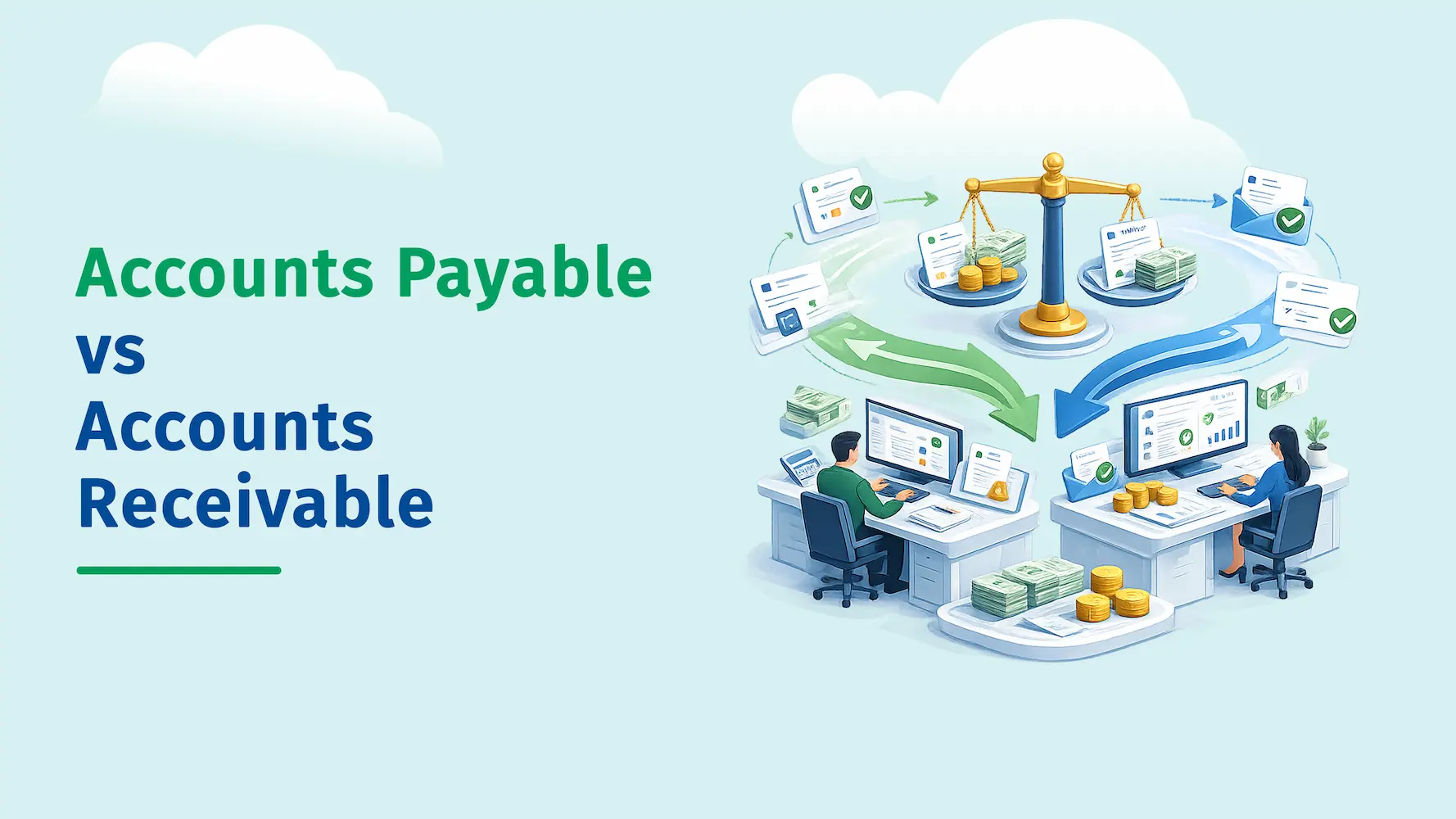
Accounts payable is money a business owes to its vendors for goods or services already received, recorded as a current liability. Accounts receivable is money owed to a business by its customers for goods or services already delivered, recorded as a current asset. Together, they represent the two sides of a company's short-term cash flow.
Mix them up, or manage either one poorly, and a company can look profitable on its income statement while quietly running out of cash to make payroll. This guide walks through what accounts payable and accounts receivable actually are, how they're recorded, how they work day to day inside a real finance department, and where they intersect to shape a business's overall financial health.
Quick Comparison: Accounts Payable vs Accounts Receivable
Accounts Payable
Owed to vendors & suppliers
Accounts Receivable
Owed by customers
The short version: accounts payable focuses on outgoing payments while accounts receivable tracks incoming payments. Everything else follows from that one distinction.
| Factor | Accounts Payable (AP) | Accounts Receivable (AR) |
|---|---|---|
| Definition | Money owed to vendors and suppliers | Money owed by customers |
| Balance sheet classification | Current liability | Current asset |
| Cash flow direction | Outgoing cash | Incoming cash |
| Who it involves | Vendors, suppliers | Customers |
| Process cycle | Procure-to-Pay (P2P) | Order-to-Cash (O2C) |
| Key metric | Days Payable Outstanding (DPO) | Days Sales Outstanding (DSO) |
| Risk when mismanaged | Late payment fees, damaged vendor relationships | Bad debt, cash shortfalls |
| Journal entry direction | Credit to increase, debit to settle | Debit to increase, credit to settle |
What Are Accounts Payable and Accounts Receivable?
Both terms describe short-term financial obligations that exist because businesses rarely pay or get paid in cash on the spot. Instead, they extend and receive credit through agreed payment terms.
When a business buys something on credit, the amount it owes becomes accounts payable. When a business sells something on credit, the amount it's owed becomes accounts receivable. The two sit on opposite sides of the balance sheet, but they're built from the same underlying idea: trade credit lets businesses operate without every transaction requiring immediate cash.
Understanding accounts payable and receivable together, rather than as two unrelated bookkeeping tasks, is what separates finance teams that manage cash well from ones that are constantly reacting to shortfalls.
What Is Accounts Payable?
Accounts payable is the money a business owes its vendors and suppliers for goods or services it received but has not paid for yet. Accounting rules classify it as a current liability, since the company is expected to settle the balance in a short window, usually somewhere between 30 and 90 days.
Why it exists. Suppliers extend credit terms such as Net 15, Net 30, or Net 45 so a business can receive inventory or services immediately and pay later. This is standard practice across nearly every industry, and it's what allows companies to keep operating without tying up cash in every single purchase.
How It Works: The Procure-to-Pay Workflow
- Requisition: A department submits a purchase requisition for something it needs.
- Purchase order: Once approved, the company issues a formal purchase order to the vendor.
- Goods receipt: The vendor delivers the goods or completes the service, and the business records a goods receipt.
- Invoice received: The vendor sends an invoice requesting payment.
- Three-way matching: The finance team compares the purchase order, goods receipt, and invoice to confirm quantities, pricing, and terms all line up.
- Approval workflow: The invoice moves through an invoice approval workflow.
- Payment scheduled: Payment is scheduled according to the agreed payment terms.
Skipping or rushing any of these steps is where most accounts payable problems start. A vendor invoice that isn't matched against the original purchase order can result in paying for goods that were never delivered, or paying the wrong amount entirely.
Why it matters. Accounts payable directly affects a company's cash position, its relationships with suppliers, and even its creditworthiness with lenders. Pay too early and the business gives up cash it could have used elsewhere. Pay too late and it risks late payment fees, strained vendor relationships, and in some cases, delayed future shipments.
What happens when it's poorly managed. Businesses that manage accounts payable manually, through spreadsheets and email approval chains, tend to see duplicate payments, missed early payment discounts, and a Days Payable Outstanding that creeps up until vendors start asking questions.
Best practices for improvement. Mature AP departments rely on AI OCR to capture invoice data automatically, workflow automation to route approvals without manual chasing, and ERP integration so approved invoices post straight into the general ledger and chart of accounts without re-keying data.
What Is Accounts Receivable?
Accounts receivable is the mirror image of accounts payable. It's the money owed to a business by its customers for goods or services already delivered but not yet paid for. It's recorded as a current asset on the balance sheet because it represents cash the company expects to collect in the near future.
Why it exists. Just as businesses receive credit from suppliers, they frequently extend credit to their own customers. This is especially common in B2B environments, where customers are invoiced under agreed credit terms rather than paying upfront. This is the core of Order-to-Cash.
How It Works: The Order-to-Cash Workflow
- Order placed: A customer places an order, often under previously agreed payment terms.
- Delivery: The business delivers the product or completes the service.
- Invoice sent: An invoice is generated and sent to the customer.
- Outstanding balance: The invoice becomes an outstanding balance until it's paid.
- Aging tracked: Finance teams track unpaid invoices using an aging report, grouped into 0 to 30, 31 to 60, 61 to 90, and 90-plus days overdue.
- Collections: If a customer falls behind, the account moves into collections, where the finance or credit team follows up to recover the balance.
Why it matters. Accounts receivable is where a lot of paper profit gets stuck. A business can report strong revenue on its income statement and still struggle for cash if customers are slow to pay. This is why Days Sales Outstanding, the average number of days it takes to collect payment after a sale, is one of the most closely watched numbers in finance.
What happens when it's poorly managed. Loose accounts receivable management leads to growing outstanding invoices, rising bad debt, and cash shortages even during periods of strong sales. Some businesses discover too late that a meaningful share of their receivables are effectively uncollectible.
Best practices for improvement. Stronger credit policies before onboarding new customers, automated invoice delivery and reminders, real-time aging visibility, and a structured collections process all work together to shorten DSO and reduce bad debt exposure.
Key Differences Between Accounts Payable and Accounts Receivable
The difference between accounts payable and accounts receivable comes down to direction and classification.
Accounts Payable
- Represents outgoing cash
- Recorded as a current liability, an obligation the business owes
- Involves vendors and suppliers
- Measured through Days Payable Outstanding
- Sits inside Procure-to-Pay
- Mismanagement shows up as late fees and damaged vendor trust
Accounts Receivable
- Represents incoming cash
- Recorded as a current asset, a resource the business expects to receive
- Involves customers
- Measured through Days Sales Outstanding
- Sits inside Order-to-Cash
- Mismanagement shows up as bad debt and cash shortfalls
Detailed Comparison Table
| Factor | Accounts Payable | Accounts Receivable |
|---|---|---|
| Balance sheet section | Current liabilities | Current assets |
| Increases with | Credit entry | Debit entry |
| Decreases with | Debit entry (payment made) | Credit entry (payment received) |
| Primary document | Vendor invoice | Customer invoice |
| Owner of the process | AP department / controller | AR department / credit manager |
| Common KPI | DPO (Days Payable Outstanding) | DSO (Days Sales Outstanding) |
| Aging report tracks | Unpaid vendor bills | Unpaid customer invoices |
| Automation focus | Touchless invoice processing, three-way matching | Automated billing, collections workflows |
| Effect on cash flow | Delays cash outflow (within terms) | Accelerates or delays cash inflow |
Similarities Between Accounts Payable and Accounts Receivable
Despite sitting on opposite sides of the balance sheet, accounts payable and accounts receivable share more in common than most people realize.
- ✓Both are short-term financial obligations, expected to be settled within a normal operating cycle, usually 12 months or less.
- ✓Both depend on payment terms negotiated in advance, whether that's Net 30 with a supplier or Net 30 with a customer.
- ✓Both require accurate invoice processing to function correctly.
- ✓Both directly affect working capital and overall liquidity.
- ✓Both benefit from the same categories of workflow automation and ERP integration.
- ✓Both are subject to internal controls and audit compliance, since they involve money moving in and out of the business.
Real Business Example
Imagine a mid-size furniture manufacturer. It buys raw lumber from a supplier on Net 30 terms and sells finished furniture to retail chains, also on Net 30 terms.
Lumber received in March, owed to the supplier under Net 30. Sits on the balance sheet as accounts payable, a current liability.
Furniture shipped to a retail chain in March under Net 30. Sits on the balance sheet as accounts receivable, a current asset.
Notice what's happening: the manufacturer owes $50,000 and is owed $80,000, both due around the same time. If the retail chain pays on time, the manufacturer has more than enough incoming cash to cover the lumber bill. But if the retailer pays late, the manufacturer may need to dip into a cash reserve or short-term financing to cover the supplier payment, even though the business is profitable on paper. This is exactly why accounts payable and accounts receivable have to be managed together, not in isolation.
Journal Entries: How AP and AR Actually Get Recorded
Seeing the debits and credits side by side makes the asset-versus-liability distinction much clearer.
Accounts Payable Journal Entry Example
A business receives $5,000 of inventory on credit:
When the invoice is paid:
Notice that accounts payable increases with a credit and decreases with a debit, consistent with its nature as a liability.
Accounts Receivable Journal Entry Example
A business delivers $8,000 of services on credit:
When the customer pays:
Accounts receivable increases with a debit and decreases with a credit, consistent with its nature as an asset. This is the accounting mechanic behind why AP and AR sit on opposite sides of every financial statement they touch.
Why accounts payable is a liability. It represents a legal obligation to pay someone else in the future. The business has already received the benefit but hasn't yet given up the cash. Under both GAAP and IFRS, any obligation expected to be settled within the normal operating cycle, or within twelve months, gets classified as a current liability.
Why accounts receivable is an asset. It represents a resource the business controls and expects to convert into cash. The business has already delivered the value and has a legal right to collect payment. Any resource expected to generate future economic benefit within the normal operating cycle qualifies as a current asset.
Cash Flow and Working Capital
Cash Flow Impact
Accounts payable and accounts receivable pull a company's cash position in opposite directions. Paying vendors reduces cash on hand, but managing accounts payable strategically, taking full advantage of payment terms rather than paying early out of habit, keeps cash available longer for other uses. Collecting from customers increases cash on hand, but only once the payment actually arrives. Revenue on the income statement doesn't equal cash in the bank until an accounts receivable balance is collected.
This gap between recognizing revenue and actually collecting cash is one of the most common reasons profitable businesses experience cash flow problems.
Working Capital Impact
Working capital is calculated as current assets minus current liabilities. Since accounts receivable is a current asset and accounts payable is a current liability, both numbers feed directly into this calculation.
A business with high accounts receivable and low accounts payable will show strong working capital on paper, but only if that receivable balance is actually collectible. A business that stretches its accounts payable too aggressively might temporarily boost its working capital position while quietly damaging vendor relationships. Managing working capital well means balancing both sides deliberately rather than optimizing one at the expense of the other.
Balance Sheet Treatment
On the balance sheet, accounts payable appears under current liabilities, typically listed alongside other short-term obligations like accrued expenses and short-term debt. Accounts receivable appears under current assets, usually listed near cash and inventory.
A sudden spike in accounts receivable without a corresponding increase in cash collected can be a red flag for slow-paying customers or overly generous credit terms. A steadily climbing accounts payable balance can signal cash flow strain, or simply a deliberate strategy to extend payment timing within agreed terms.
Cash Conversion Cycle
The cash conversion cycle ties accounts payable and accounts receivable together in a single formula:
This measures how long it takes a business to convert money spent on inventory and operations back into cash from sales. A shorter cash conversion cycle means cash returns faster than it goes out, a sign of strong liquidity. A business that collects from customers quickly while taking full advantage of vendor payment terms, without incurring late fees, keeps its cash conversion cycle tight. A business that pays vendors quickly but collects from customers slowly can look profitable while quietly running low on cash.
KPIs Finance Teams Should Monitor
Days Payable Outstanding
The average number of days a business takes to pay its vendors. A higher DPO, within agreed terms, generally means better cash retention, but pushing it too far risks vendor relationships.
Days Sales Outstanding
The average number of days it takes to collect payment after a sale. A lower DSO means faster cash collection and less cash tied up in accounts receivable.
Collection Effectiveness Index
Measures how effectively a finance team collects on outstanding receivables compared to what was theoretically collectible. Closer to 100% means a highly effective collections process.
Aging Reports
Both AP and AR aging reports bucket outstanding balances by how overdue they are, giving finance teams an early warning system before a small delay turns into a serious cash problem.
Common Mistakes Businesses Make
On the Accounts Payable Side
- Approving vendor invoices without three-way matching, which opens the door to duplicate payments and billing errors
- Missing early payment discount windows because invoices sit too long in a manual approval queue
- Losing visibility into upcoming obligations, which makes cash forecasting unreliable
On the Accounts Receivable Side
- Extending credit terms to new customers without checking payment history
- Waiting too long to follow up on overdue invoices, allowing aging balances to slide into the 90-plus day range
- Treating collections as an afterthought instead of a structured, recurring workflow
Shared mistake: Managing both functions through spreadsheets and email. Manual invoice processing, whether inbound on the AP side or outbound on the AR side, remains the single biggest source of errors, delays, and lost visibility in finance departments that haven't automated.
Common Myths About Accounts Payable and Accounts Receivable
A high accounts receivable balance always means a healthy business.
Not necessarily. If a large share of that balance is aging past 90 days, it may never actually be collected.
Paying vendors as early as possible is always the smart move.
Paying early, ahead of the agreed terms, gives up cash the business could have used elsewhere, unless there's a meaningful early payment discount that outweighs the cost of tying up that cash sooner.
Accounts payable and accounts receivable are entirely separate departments with nothing in common.
In practice, both feed into the same working capital calculation and the same cash conversion cycle, and both benefit from the same categories of automation.
Automation removes the need for accounting knowledge.
Automation speeds up data capture, matching, and routing, but the underlying accounting principles, and the judgment calls around credit terms and vendor relationships, still require experienced finance professionals.
AP and AR Automation
AP Automation
- AI OCR to read and capture data from incoming vendor invoices
- Automated three-way matching against purchase orders and goods receipts
- Workflow automation for approvals
- Duplicate invoice detection to catch billing errors before payment
- ERP integration so approved invoices post directly to the general ledger
AR Automation
- Automated invoice generation and delivery
- Scheduled payment reminders tied to due dates
- Real-time aging report visibility
- Structured collections workflows that flag overdue accounts
- Automated payment reconciliation against open invoices
Automating accounts payable and accounts receivable delivers benefits on both sides of the balance sheet: fewer manual errors, faster processing times, better visibility into upcoming cash obligations and expected collections, stronger internal controls and audit trails, and more accurate cash forecasting. None of this changes the underlying accounting. AP is still a liability, AR is still an asset, but it dramatically improves how quickly and accurately that information reaches the people making decisions with it.
For organizations running Salesforce, Quick Payable handles the AP side of this equation directly, matching invoices, routing approvals, and posting to the general ledger without leaving the Salesforce environment.
Conclusion
Accounts payable and accounts receivable are two key parts of healthy cash flow. Accounts payable (AP) is money your business owes suppliers, while accounts receivable (AR) is money customers owe your business. Managing both well helps improve cash flow, working capital, and financial stability.
Strong AP and AR processes reduce payment delays, improve customer and vendor relationships, and support better financial decisions. With the right tools and automation, businesses can speed up approvals, collect payments faster, reduce errors, and keep cash flowing smoothly.
Frequently Asked Questions
Why is construction AP difficult to manage?
Construction invoices often include cost codes, progress billing, retainage, and multiple approvals. Manual processes make them harder to track and approve on time.
How is construction AP automation different?
It routes invoices by project, job, and cost code, helping field teams and finance approve invoices faster without manual tracking.
Can it handle retainage and partial payments?
Yes. The system tracks retainage, partial payments, and progress billing in one place, reducing manual work and errors.
How does it help subcontractors?
It provides clear payment status, speeds up approvals, and helps subcontractors receive payments on time.
When should contractors automate AP?
AP automation is most valuable when managing multiple projects, growing invoice volumes, or distributed job sites.
Can it manage progress billing?
Yes. It checks payment applications against the schedule of values to keep progress billing accurate.
Does it support audits and compliance?
Yes. Approval history, lien waivers, and compliance documents stay linked to each invoice for easy audits.
Can specialty contractors use it?
Yes. Electrical, plumbing, mechanical, roofing, and other contractors can customize approval rules and invoice routing.
Is it suitable for civil and infrastructure projects?
Yes. It supports milestone billing, long-term projects, and the documentation required for public contracts.