
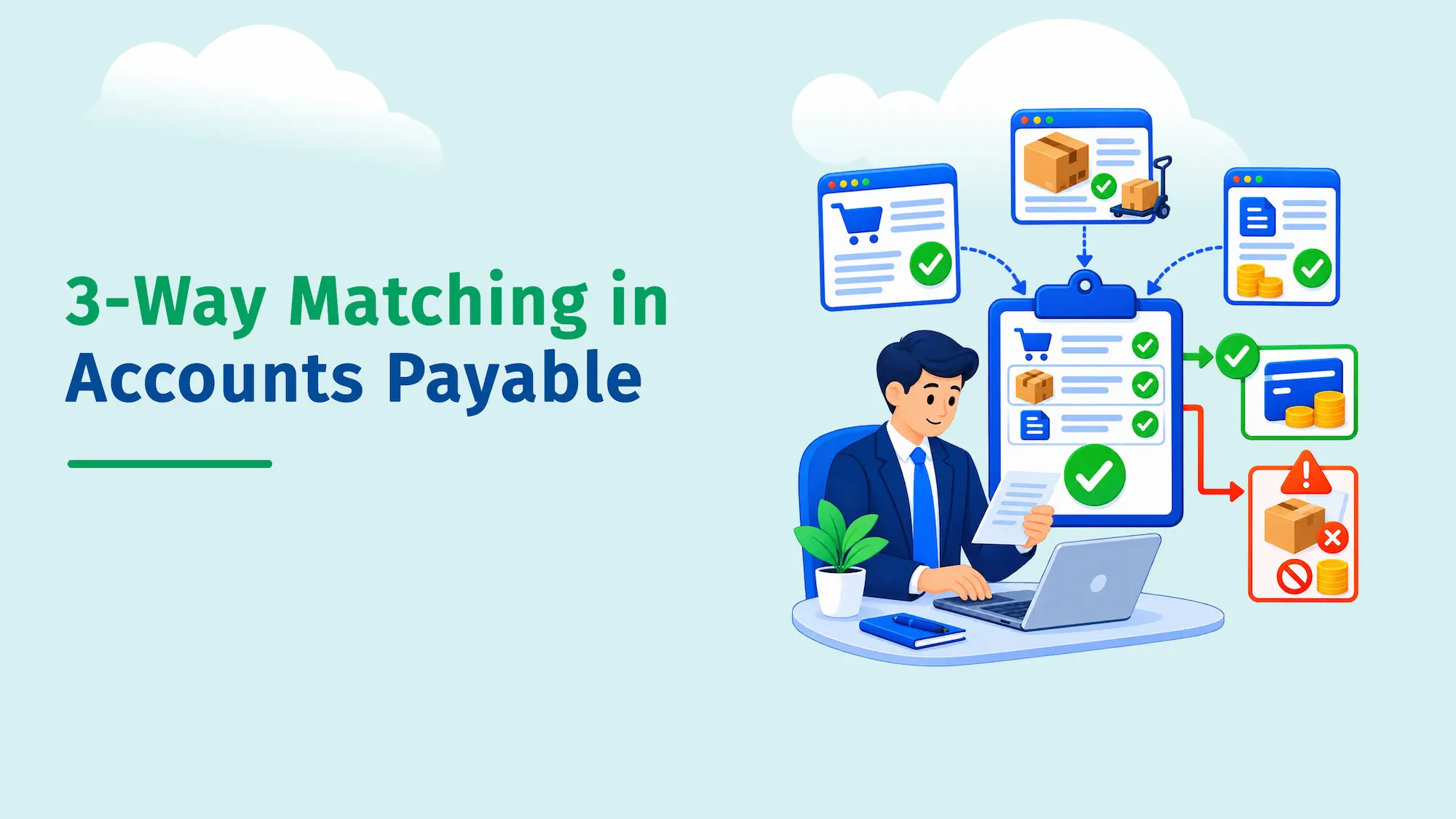
3-way matching in accounts payable is a control that compares three documents before a supplier invoice is approved for payment: the purchase order, the receiving report or goods receipt, and the supplier invoice. If the item, quantity, and price agree across all three, the invoice is cleared for payment. If they do not, the invoice is held as an exception until the difference is resolved.
- 3-way matching checks that the company ordered the goods, received them, and was billed the agreed amount.
- 2-way matching compares only the purchase order and the invoice, so it cannot confirm that goods arrived.
- Tolerance rules let small, approved variances pass without manual review.
- Automated 3-way matching clears most invoices without manual review and routes only the exceptions to people.
The Three Documents in 3-Way Matching
3-way matching relies on three documents created by three different teams, which is what makes it an effective control. Each document answers a different question about the purchase.
Purchase Order
The purchase order (PO) is created by purchasing and approved before the order is placed. It records what the company agreed to buy: the item, quantity, unit price, total, delivery terms, and supplier. The PO answers the question "did we authorize this purchase?"
Receiving Report or Goods Receipt
The receiving report, also called a goods receipt note, is created by the warehouse or receiving team when the delivery arrives. It records what was actually received, including quantities and the condition of the goods. It answers the question "did we receive what we ordered?"
Supplier Invoice
The supplier invoice is sent by the vendor and requests payment. It lists the items, quantities, prices, taxes, and payment terms the supplier is billing. It answers the question "are we being charged the right amount?"
How the 3-Way Matching Process Works
The 3-way matching process in accounts payable follows five steps: capture the invoice, find the related purchase order and receipt, compare line items, check variances against tolerances, and then approve the invoice or route it as an exception.
- Capture the invoice and enter or extract its header and line data.
- Use the PO number on the invoice to find the purchase order and any goods receipts recorded against it.
- Compare item codes, quantities, and unit prices across the three documents.
- Accept differences that fall within approved tolerance limits.
- Send matched invoices to payment and route unmatched invoices to the right owner for review.
Line-level matching matters. An invoice can match the PO total while still charging a higher price on one line and a lower quantity on another.
3-Way Matching Example
A manufacturer orders 500 units of a component at $20 each. The warehouse receives 480 units. The supplier invoices 500 units at $20.
| Document | Quantity | Unit Price | Total |
|---|---|---|---|
| Purchase Order | 500 | $20.00 | $10,000 |
| Receiving Report | 480 | — | — |
| Supplier Invoice | 500 | $20.00 | $10,000 |
The invoice matches the PO but not the receipt. The company has been billed for 20 units it did not receive, so the invoice fails the 3-way match. Accounts payable holds it and either pays $9,600 for the 480 units received after confirming with the supplier, or waits for a corrected invoice or the remaining delivery. Without the receiving check, the company would have overpaid by $400.
2-Way Matching vs 3-Way Matching in Accounts Payable
2-way matching in accounts payable compares only the purchase order and the invoice, confirming that the price and quantity billed agree with what was ordered. 3-way matching adds the receiving report, confirming that the goods were actually delivered. 3-way matching is stronger for physical goods, while 2-way matching is often enough for services where no goods receipt exists.
| Item | 2-Way Matching | 3-Way Matching | 4-Way Matching |
|---|---|---|---|
| Documents compared | PO and invoice | PO, receipt, and invoice | PO, receipt, inspection, and invoice |
| Confirms delivery | No | Yes | Yes |
| Confirms quality | No | No | Yes |
| Typical use | Services, low-risk or low-value purchases | Physical goods, inventory | Regulated or quality-critical goods |
Many companies use different match types for different spend categories, for example 2-way for subscriptions and services and 3-way for inventory and materials.
Tolerance Rules in Three-Way Matching
Tolerance rules define how much difference between the PO, receipt, and invoice is acceptable before an invoice is flagged. Without tolerances, small rounding differences or freight charges would send large numbers of valid invoices to manual review.
Common tolerance settings include:
- A percentage price variance per line, such as 1% or 2%
- A fixed dollar variance per line or per invoice
- A quantity variance for goods sold by weight or volume
- Separate rules for freight, tax, and surcharges
Tolerances should be set by finance and purchasing together, reviewed periodically, and kept tight for high-value or high-risk suppliers. Loose tolerances defeat the purpose of the control.
Common 3-Way Match Exceptions and How to Resolve Them
A 3-way match exception occurs when the documents disagree beyond tolerance. The most common exceptions are price variances, quantity variances, missing goods receipts, invoices without a PO number, and duplicate invoices.
Price Variance
The invoice price is higher than the PO price. Purchasing confirms whether a price change was agreed; if not, AP requests a credit memo or corrected invoice.
Quantity Variance
The invoice bills more units than were received. AP pays for the received quantity or holds the invoice until the remaining goods arrive.
Missing Goods Receipt
The goods arrived but the receipt was not recorded. Receiving posts the goods receipt, and the invoice is matched again.
Missing or Incorrect PO Number
The invoice cannot be linked to a purchase order. AP contacts the supplier or requester to identify the PO, or routes the invoice through a non-PO approval process.
Duplicate Invoice
The same invoice is submitted twice, sometimes with a slightly changed number. Duplicate checks on supplier, amount, and date catch these before payment, and duplicate invoice detection adds a separate layer of protection when invoice numbers differ.
Benefits of 3-Way Matching in Accounts Payable
3-way matching prevents overpayment for goods not received, stops payment of unauthorized purchases, reduces duplicate and fraudulent payments, creates an audit trail for each invoice, and gives purchasing data on supplier accuracy. It is also one of the core accounts payable internal controls that auditors test.
The control is also useful for supplier management. Suppliers with frequent price or quantity variances can be identified and addressed in contract reviews.
Limitations of Manual Three-Way Matching
Manual three-way matching is slow and error prone at volume. AP staff must find three documents, often in different systems, compare each line, and chase receiving or purchasing for missing information. As invoice volume grows, teams either fall behind or start skipping line-level checks, which weakens the control.
Manual matching also delays payment. Invoices waiting for a receipt or PO confirmation can miss early payment discounts or cause late payment to suppliers, which strains relationships.
Automating 3-Way Matching in Accounts Payable
Automated 3-way matching extracts invoice data, links it to the purchase order and goods receipt from the ERP, compares every line against tolerance rules, and approves matched invoices without manual review. Only exceptions are routed to people, along with the reason the match failed.
Automation depends on three things: accurate invoice data capture, reliable access to PO and receipt data, and well-defined tolerance rules. AI OCR invoice processing captures line-level invoice data, while accounts payable ERP integration keeps purchase orders and receipts available for matching.
Quick Payable runs inside Salesforce and performs three-way matching on captured invoices, flags variances for review, and keeps a record of each match decision. Matching fits within the broader invoice processing in accounts payable workflow, from capture through approval and payment.
Frequently Asked Questions
What is 3-way matching in accounts payable?
3-way matching in accounts payable is a control that compares the purchase order, the receiving report, and the supplier invoice before payment, to confirm the goods were ordered, received, and billed correctly.
Which three documents are used in a 3-way match?
The three documents are the purchase order, the receiving report or goods receipt, and the supplier invoice.
How does 2-way matching differ from 3-way matching?
2-way matching compares the purchase order and the invoice. 3-way matching also compares the receiving report, which confirms that the goods were actually delivered.
When is 2-way matching enough?
2-way matching is usually enough for services, subscriptions, and low-risk purchases where there is no physical delivery to record.
What happens when a 3-way match fails?
When a 3-way match fails, the invoice is held as an exception and routed to the right person, such as purchasing or receiving, to resolve the difference before payment.
Can 3-way matching be automated?
Yes. Automated systems capture invoice data, match it to purchase orders and receipts, apply tolerance rules, and approve matched invoices, sending only exceptions for manual review.

Shyam Agarwal is a technology professional with 12+ years of experience in Salesforce consulting, development, and administration. He writes about accounts payable, AP automation, and Salesforce, drawing on his experience delivering scalable technology solutions that support business needs and improve operational efficiency.